Feeds:
Posts
Comments

phrasesEver since I stepped onto the pathway to write a novel, I’ve never stopped reading or listening to stories written by the many talented authors we now enjoy. Whenever I hear a phrase that rings true to my characters or my plotline, I jot them down for possible use in my own story. I can usually picture the exact scene and paragraph in my manuscript where a particular phrase will fit perfectly.

At the various conferences and workshops I’ve attended over the years, several class leaders have advised that this “borrowing” is an accepted practice, and that the original creator of the phrase should be flattered!

However, in the interest of not plagiarizing another author’s efforts, I strive to alter the actual words while keeping the spirit of the phrase intact.  Here are a few examples of recent gems:

“She drew a shaky breath”; “her voice vibrated with rage”; “he eased off the gas pedal”, “she cast a suspicious look”; “he nodded her into a chair”; “she depressed the disconnect button”.

I will continue to listen for other delightful phrases that have potential to transform my story into a more textured and interesting read.



revision by handWhen I first decided to write a mystery novel, simply because I loved to read them, I had no idea how complicated it could get. Choosing the right words and putting them on the page in the proper order is not so easy as you would think!

In addition to the basics questions like who will my characters be, where will my story take place, and what’s the problem that will move the story along, there is an endless list of other details that must be woven into the pages. Character arc, subplot, logical dialogue, scenes that evolve from cause and effect, and varied sentence beginnings.

And, of course, with every conference or on-line course, other facets come into play. Recently, someone handed me an article about sensory detail and how adding sight, sound, smell, touch, and taste can add depth and texture to a story. And let’s not forget the sixth sense: intuition. Each scene should have at least one, but make sure it’s appropriate to the characters and setting.

Another workshop advised that each page needs to include three elements: Feelings, Action, and Thought. Notice the acronym FAT!

And so I continue to revise, and hopefully improve my mystery! One of these days, I might actually feel that it’s as finished as I can make it. The trick will then be to find an agent who agrees with me that my story is worthy of publication!

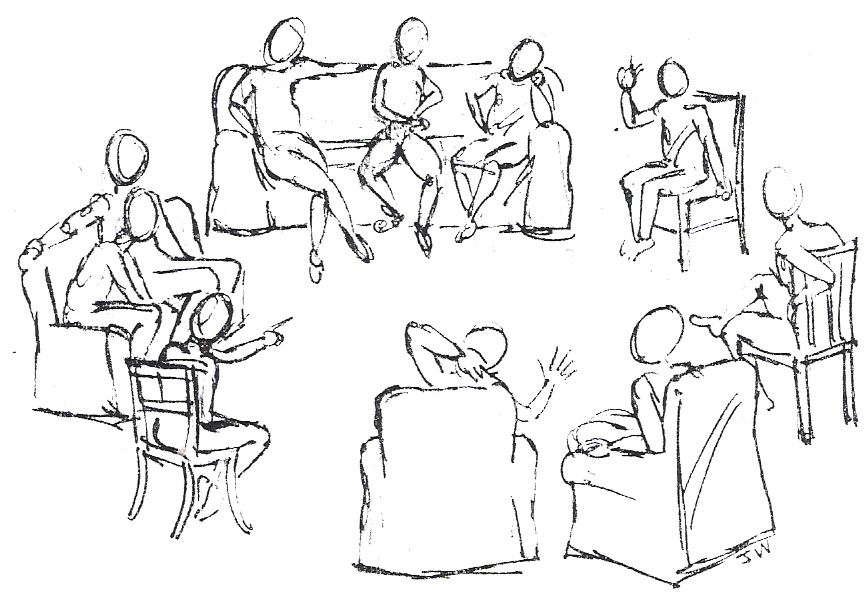
group discussion2This week heralded the 51st Anniversary of the Cape Cod Writers Center Conference. Previously hosted in the quaint village of Craigville, last year the conference organizers found it necessary to move to the larger and more attendee-friendly Resort and  Conference Center of Hyannis, Massachusetts. With the growing number of attendees, the need for additional parking and WiFi access became crucial.

The classes offered were top-notch, with instructors from around the country. One of my classes was titled, “Five Pillars of Promotion”, and detailed the actions necessary ahead of publication, along with a timeline to insure that a newly printed book is well received.

Another class was called, “Pitches, Queries, and Proposals”. This workshop was taught by a husband-wife team who entertained us with their friendly disagreements.

My third and final session was named, “Conference Idol”, and was perhaps the most valuable hour I spent this past week. Three agents sat at the front of the room. Each attendee submitted their first page, identified only by title and genre. As the page was read, each agent lifted her hand when she heard something that would cause her to stop reading. When two hands went up, the reader halted her recitation, and the agents explained why they would go no further if this story was submitted to them for consideration. Whether they were commenting on my first page or someone else’s, the insight garnered from the perspective of the agents was invaluable.

As a bonus, one of those agents offered to sit down with me and review my first page word by word. I readily accepted, and she suggested several improvements, among them moving a strong sentence halfway down the page to be the first sentence. What a difference that made! I must have rewritten that first page more than twenty… or more!…times, but I now think it’s finally beginning in the most provocative part of the story.

I’m looking forward to my next conference, held in November, called “CrimeBake’, sponsored by the New England chapter of Sisters in Crime. This conference is devoted to mysteries, and will no doubt be as equally valuable.

sketch of question personOK… so I’ve been wrestling with my opening chapter for what seems like forever. I’ve read many writing craft books. One craft book says the author can’t mess with normal until your reader knows what normal is.

And so I’ve arrived at a quandary… how do I hook my reader [and my first reader is an agent] with the inciting incident and show my main character’s normal life at the same time?

A while ago, I attended an event at a local library called Author Idol, where the 25 authors sitting in the audience had each submitted their anonymous first three pages. The four agents up on stage raised one hand when the reader came to a place where the agent would reject the manuscript. Two agents’ hands in the air signaled the reader to stop. Would it surprise you to hear that most of us didn’t get past the first two paragraphs???

How scary is that???

How perfect does that opening have to be???

What happened to editors???

If an agent is not willing to read at least the first three pages, what hope do I have of ever getting published?

So it’s back to the drawing board. On Saturday, I’ll submit to my writing group yet another attempt at my opening. My fingers are crossed that I’m at least getting closer.

sketch of question personThis past weekend, I attended the Malice Domestic Conference in Bethesda, MD. Although this mystery gathering is more an opportunity for fans to meet their favorite authors, a writer can also glean valuable information from the various panels.

In addition to author breakfasts, interviews, and the Poison Lady, I chose these panels: When Secrets and Lies Descent into Murder, Mysteries with a Touch of Magic, How Seasons Effect Story, Sleuthing with the Dead, When Music and Painting Lead to Murder, and Cozy in the City.

Carolyn G. Hart, one of my favorite authors who is publishing her 50th novel this year, spoke with me about writing, and not letting anyone try to change my words into their own.

On the other hand, when I asked a panel of published mystery authors when their body drops, here are their answers: first sentence, first chapter, first paragraph, and prologue. Another author on a different panel said it has to drop no later than the last chapter you submit to an agent, which is usually the first three. That beats the crap out of my body drop 1/3 of the way through my story. So now I need to decide whether to tackle a major rewrite and move it forward…sigh.

Not sure I will attend this particular conference until my own novel is published. That could be next year or a decade from now…who’s to know?


sketch of question personThere are several publishing houses out there who do not require an agent. This sounds tempting until I read the fine print for their submission guidelines.

The one that I’m considering requests a query email, a 2-5 page synopsis and the entire manuscript as attachments.

My concern centers around my constant worry that someone will ‘borrow’ my story without my knowledge. Compared to the usual process that an agent requires, which is a query letter first, after which they request perhaps the synopsis and possibly the first three chapters, it seems to me that providing everything upfront, electronically, with no prior interaction with a human being puts me at somewhat of a disadvantage.

Am I being a bit paranoid? Probably.

I’d be interested to hear from those of you who are published whether you worked through an agent or dealt directly with a publisher.

Agent Email

In my inbox this morning sat an email from an agent I recently queried. She represents another cozy mystery writer in the Sisters In Crime organization, and was recommended to me by another agent.

My fingers paused above the file, not sure if they wanted to open it or not. Would I be lucky and get a hit on nearly my first try? Or would she tell me ‘Thanks, but no thanks.’ ???

After several minutes of debate, I hit the enter key and zoomed in on her words like a starving writer…only to be disappointed. Her rejection said my hook was not sufficient to interest any of the editors she knows.

Big sigh.smiley face maybe next time

I’ve been told by both my writing groups that I’ve written a good story, so I’ll be pulling down my how-to books about query letters and improving this one paragraph description by echoing the tension and frustration of my main character.

On a positive note, the only way is up!

Craft of Writing

emotion

Traveling this long and interesting road since I decided to try my hand at writing a novel has been a real eye opener. Who knew there was so much involved in putting my story on paper? I respect authors who have written an engrossing story, then managed to find an agent and a publisher. On the other hand, I’m sometimes disappointed with the quality of writing, wondering how a book managed to get published at all.

This brings me to my fear of putting my story out there if it’s not as perfect as I can make it. Fascinating characterization, interesting setting, thoughtful plot line, and control of back story.  I’ve become a great lover of books written to educate a new writer. Most recently, I bought one called “The Emotion Thesaurus”. It  provides a laundry list of examples to write the emotions of your characters without falling into the trap of cliche. As my writing group points out on a regular basis, I sometimes forget to include my protagonist’s emotions, assuming that the reader understands what’s going on in my characters’ heads. Wrongo!

As I’ve been reading through this new how-to book, I’m inspired to go back into my story and find places where the emotional impact of a scene can be more accurately shown…never told!…to make my protagonist more human.

If you have a favorite book about the craft of writing, I’d love to hear about it. Always looking for new volumes to add to my ever-expanding library.


…to send it out!!!

After many, many revisions, my story finally begins in the right place…I think.

My stronger protagonist encounters the “inciting incident” by the end of page seven.

I’ve moved evil back story into future chapters.

I’ve eliminated narrative that interrupts the plot.

I’ve eliminated duplications and replaced weak verbs with stronger ones.

I’ve been mindful that my internal and external character arc mesh and mingle.

I’m hopeful that readers will be hooked and not put it down until page 309…The End.

So why am I petrified to enter it into a contest for first time novelists!

Where do I find the nerve to JUST DO IT? …no idea.

My calendar is marked with a deadline of mid-October… will I push the button? Stay tuned.

Online Class

During the past two weeks, I’ve been participating in an on-line course titled: “Revising Without Getting Sick of Your Manuscript” by Sylvie Kurtz.  The lessons were provided daily via both email and the Yahoo Group website. Each day brought a different aspect of writing fiction:

8-20 – 1.  Introduction

8-21 –  2.  General Outlook

8-22  – 3.  Plot and Structure

8-23 –  4.  Point of View

8-24  – 5.  Scenes

8-25 –  6.  Characters

8-27 –  7.  Dialogue

8-28 –  8.  Backstory

8-29 –  9.  Opening and Endings

8-30 – 10.  Voice, Style, and Details

8-31 – 11.  Conclusion

Sylvie is a fount of knowledge for each topic and provided examples to illustrate the point of each lesson. Her explanations and guidelines were easy to understand. But the best part of it all was her feedback! With her guidance, I now own a respectable pitch that I can send off to agents and publishers.

If you ever have the opportunity to take a course with Sylvie, I highly recommend that you do!